
• Country
    • Main Menu
    • China
    • Germany
    • Italy
    • Liechtenstein
    • Austria
    • Poland
    • Romania
    • Switzerland
    • Hungary
  • Language
    • Main Menu
    • Deutsch
    • English
  • Alliance Portal
  • Client Portal
  • Offices & Contact
Funk
  • Funk
  • Risk fields
    • Zurück
    • Risk fields
      • AI in business: risks and opportunities
      • Cyber Risks
      • ESG risks
      • Political Risks
      • Liability Risks
      • Property Damage
      • Show all
    • FEATURED

      Technical articles
  • Services
    • Zurück
    • Risk management
      • Enterprise risk management
      • Funk Beyond Insurance
      • Risk Academy
      • Sustainability consulting with Funk
    • Insurance management
      • D-O insurance
      • Claims management
      • Client portal
      • Special services
      • International
      • Show all
    • FEATURED

      ‘MyFunk’ client portal
  • Industries
    • Zurück
    • Industry
      • Automotive
      • Construction Project
      • Energy
      • Chemical
      • Food
      • Logistics
      • Alle anzeigen
    • Property sector
    • Health and social affairs
    • Other industries
    • Service providers
    • Art & events
    • Independent professions
    • Trade
    • Associations
    • Local authorities
    • FEATURED

      Real Estate Industry
  • Icon: Drei Personen in einer Gruppe About Funk
    • Zurück
    • Family-run company
      • Our Funk Values & Purpose
      • Strategy
      • History
      • Funk Foundation
    • Innovations
    • Sustainability
    • Diversity & Inclusion
    • Offices
    • FEATURED

      Our Values & Purpose
  • Media
    • Zurück
    • Our Media
    • Technical articles
    • FEATURED

      Technical articles
  • Country
    • Zurück
    • China
    • Germany
    • Italy
    • Liechtenstein
    • Austria
    • Poland
    • Romania
    • Switzerland
    • Hungary
  • EN
    • Zurück
    • DE
    • EN
  • Alliance Portal
  • Client Portal
  • Offices & Contact
Contact us
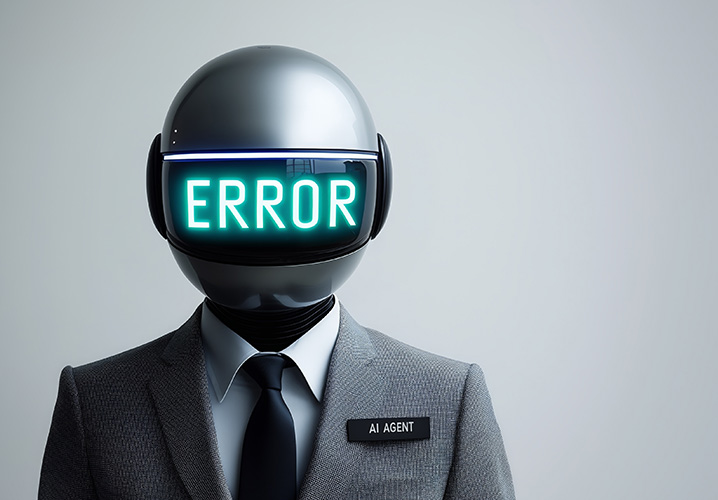
Ein Roboter in Anzug mit Fehleranzeige drückt das Gefühl von Technologieversagen und Unbehagen aus. Ein humanoider Roboter im Anzug mit dem Schriftzug 'ERROR' auf dem Kopf, vermittelt eine futuristische und fehlerhafte Stimmung.
Ein Roboter in Anzug mit Fehleranzeige drückt das Gefühl von Technologieversagen und Unbehagen aus.
  1. en
  2. Media
  3. Technical articles
  4. Insurance management
  5. Impact of AI on insurance coverage

AI as a challenge for insurability

Artificial intelligence (AI) increases efficiency and optimizes processes in almost all industries. However, its use also poses challenges for the insurability of companies. About AI misjudgments, deepfakes, and liability risks along the value chain.

AI is now simply part of everyday life: as an assistant in office processes, as an optimization machine in logistics and production, or as a building block in software products. However, the more AI influences core processes and the more autonomously it prepares or makes decisions, the more often a promise of productivity turns into a risk area that can trigger classic damage scenarios. "Property damage, business interruption, liability claims, cyber incidents, or fraud are just a few examples of how broad the risk area of AI can be," says Alexander Skorna, Managing Director of Funk Consulting. "The risk depends less on the buzzword AI and more on where it is used, how high the degree of automation is, and which control mechanisms, such as internal approvals, verifications, or plausibility checks, are actually effective." 

External studies confirm this development. In the Allianz Risk Barometer 2026, AI is listed as a global business risk for the first time and ranks second. The World Economic Forum's Global Risks Report 2026 also shows that risks related to information integrity and technology are becoming increasingly important. Misinformation and disinformation are among the most serious risks.

Ihr Kontakt

Dr. Alexander Skorna Ansprechpartner bei Funk

Dr. Alexander Skorna

+49 40 35914-0
Write E-Mail

Nadine Bewarder

+49 40 35914-0
Write E-Mail
Ihre Kontaktanfrage wurde versendet.
Please fill the mandatory fields.

Contact Form

By submitting the contact form, you agree that your data will be used to process your request. You can find further information and revocation instructions in the data protection statement.

Allianz Risk Barometer 2026

The insurance company Allianz describes AI as closely linked to cyber and sees challenges in implementation and governance, liability and reputation risks, and the role of AI in misinformation and disinformation, among other things.

About the study

WEF Global Risks Report 2026

In its latest report, the World Economic Forum ranks misinformation, disinformation, and cyber insecurity among the most significant global risks. Negative consequences of AI have seen the biggest jump in the rankings, rising from 30th to 5th place. The report emphasizes that technological innovations open up enormous opportunities, but at the same time increase risks for labour markets, information integrity, and security systems. 

About the study

"Many AI risks do not materialize as new types of damage, but as familiar events with unusual origins,"

Nadine Bewarder

Chains of causes arise anew

"Many AI risks do not materialize as new types of damage, but as familiar events with unusual origins," says Nadine Bewarder, Head of Funk Market Management. When AI is used in production or operational processes, misinterpretation of sensor data or framework conditions can lead to control errors. An example from industrial property insurance illustrates the emergence of new chains of causality: If an AI system controls valves for flammable liquids and incorrectly assesses a situation as non-critical, this can lead to leakage, ignition, and subsequently fire or explosion damage. For the insurance contract, the damage initially looks like classic fire damage—only the causality is more complex.

The mechanism is similar in logistics and transport. AI-optimized route planning and tight time windows can increase operational pressure, making operating errors during loading and unloading more likely. In temperature-controlled supply chains, errors in AI-supported monitoring can lead to spoilage of goods. "In addition, there are new interface risks – for example, from autonomous loading and unloading systems or system failures that cause downtime and delivery delays," says Alexander Skorna. At the same time, the risk of manipulation is increasing, for example through fake freight carriers or AI-supported social engineering attacks.

Criminals attack with AI, companies protect themselves with it

AI acts as an accelerant for cybercrime and damage to trust. "Attacks are becoming more professional, faster, and more targeted, for example through automated phishing campaigns that are absolutely convincing," explains Nadine Bewarder. At the same time, companies can also use AI defensively, i.e., to protect themselves against such attacks. In practice, this leads to a cat-and-mouse game in which risk assessment and premium development depend more heavily on actual security maturity. The effect is particularly visible with deepfakes. Here, voice and video simulations are circumventing previously proven control routines and increasing the risk of payment fraud or identity theft.

This creates an area of tension in terms of liability law. Nadine Bewarder: "On the one hand, autonomous systems and learning models shift chains of responsibility between manufacturers, operators, and users. On the other hand, many sets of conditions and basic legal assumptions are historically geared toward an analogue world." Especially where systems learn and change independently, the question of whether risks are still considered sufficiently tested and how due diligence can be demonstrated in practice becomes increasingly important.

Futuristischer Mikrochip mit leuchtendem 'AI'-Symbol, umgeben von digitalen Datenströmen in blauen und goldenen Tönen.

Important building blocks for insurability

In many sectors, policies still do not distinguish between damage caused by human error, a technical defect, or an AI-related misjudgment. "AI is often neither explicitly included nor excluded in insurance contracts," says market expert Nadine Bewarder. "Nevertheless, it is likely that the market will continue to evolve—similar to cyber insurance—and that insurers will define clearer requirements, obligations, or restrictions in the medium term. That's why it's having a look at the existing coverage modules and their interfaces now."
 

Property and cyber insurance are the central pillars for companies

For AI-influenced business processes, property and machinery insurance are initially the main focus, including their consequences in terms of business interruption. The decisive factors here are how consequential damage, software components, and demarcations from any existing cyber policies are regulated.

In the event of attack scenarios and data protection incidents, cyber insurance remains a central pillar, supplemented by useful services for incident response, forensics, and business interruption as a result of an IT failure. At the same time, companies should consciously check which exclusions typically apply, for example, in relation to copyright or patent law issues.

It is worth having a closer look at fidelity and liability insurance policies

Anyone who wants to protect themselves against AI-accelerated payment fraud should carefully design their crime or trust damage module. It is not only the sum insured that is decisive here, but often also whether social engineering cases are appropriately defined and whether internal control processes meet regulatory and contractual requirements.

"On the liability side, it is worth having a close look at business and product liability and, depending on the business model, also at financial loss liability and tech D&O," says risk expert Alexander Skorna. "If AI is part of a product or service, third-party damages and the resulting liability issues can quickly become a core risk." 

Manipulation with AI in goods transport and management liability

In transport programs, in addition to damage to goods, there is an increasing focus on manipulation, consequences of failure, and the question of how liability regimes apply when AI misjudgments play a role in the process.

Last but not least, AI governance can also touch on management issues. If supervision, compliance, or risk management do not keep pace with the use of AI, D&O-relevant allegations may arise. This is not automatic, but it is another reason to treat AI not as an isolated tool, but as an integral part of corporate management and, above all, holistically in risk management.

AI risks and opportunities for businesses

Hardly any other technology has changed processes as quickly as artificial intelligence. On the one hand, AI can be used to manage huge amounts of data, recognize patterns, and speed up decision-making. On the other hand, the use of AI can lead to wrong decisions and facilitate attacks from outside. In our risk field, we examine both sides.

Learn more

Solutions for AI in value creation

Studies and practical experience point in the same direction: AI will become more deeply integrated into the core processes of the value chain in the coming years. This will increase the relevance of resilience, liability issues, and clean insurability. The solution is rarely "more insurance at any price." Instead, companies should create transparency about where AI is actually used in their own business, what scenarios may arise from this, and what coverage and contract details these scenarios entail.

We would be happy to engage in a technical risk dialogue with you to analyse and evaluate your individual value chain in a structured manner. We accompany you from the classification of your AI applications and their degree of automation, through governance and controls, to coverage interfaces and optimization options in your existing insurance portfolio. Together, we will find a suitable solution—please feel free to contact us.

  

Business interruption analysis with the Funk SMART BU Check

In a world of interconnected supply chains, business interruptions can cause significant financial damage. Management should therefore be aware of the worst-case scenario and take out business interruption insurance to cover their needs. A hardening of the market for such insurance creates additional challenges.

Mehr erfahren

Ihr Kontakt

Dr. Alexander Skorna Ansprechpartner bei Funk

Dr. Alexander Skorna

+49 40 35914-0
Write E-Mail

Nadine Bewarder

+49 40 35914-0
Write E-Mail
Ihre Kontaktanfrage wurde versendet.
Please fill the mandatory fields.

Contact Form

By submitting the contact form, you agree that your data will be used to process your request. You can find further information and revocation instructions in the data protection statement.

Back to top

The best recommendation. Funk.

  • Risk fields

    • Risk fields
  • Services

    • Risk management
    • Insurance management
  • Industries

    • Industry
    • Property sector
    • Health and social affairs
    • Service providers
    • Art & events
    • Independent professions
    • Trade
    • Associations
    • Local authorities
  • About Funk

    • Family-run company
    • Innovations
    • Sustainability
    • Diversity & Inclusion
    • Offices
  • Media

    • Our Media

    Technical articles

+49 40 35914-0
Headquarters Hamburg, Valentinskamp 20, 20354 Hamburg
All offices
welcome(at)funk-gruppe.de

International Insurance Broker and Risk Consultant

  • Legal information
  • Privacy statement
  • Mandatory information
  • Supply Chain Due Diligence Act
  • Whistleblowing system
  • Sitemap